

7 Reasons Doctors Recommend a Carotid Doppler Ultrasound Test
Overview of Carotid Doppler Ultrasound
A carotid doppler ultrasound test is a non-invasive, safe imaging procedure used to examine the carotid arteries in the neck. The test employs high-frequency sound waves to create real-time images of the arteries. This testing process enables doctors to determine the presence of plaque accumulation, arterial blockages, and arterial constriction, which increase stroke risk.
The carotid ultrasound test is painless and usually intended for early diagnosis and preventive health checks. The test enables doctors to detect arterial conditions at their earliest stage, thereby improving treatment for cardiovascular and vascular conditions.
At ScanX, we intend to provide high-quality diagnostic services with assurance of transparent pricing and affordable healthcare for patients. When patients opt for ScanX for a Carotid Ultrasound Test, there will be assurance of accurate diagnostics along with cost-effective and patient-friendly services.
What Is a Carotid Ultrasound?
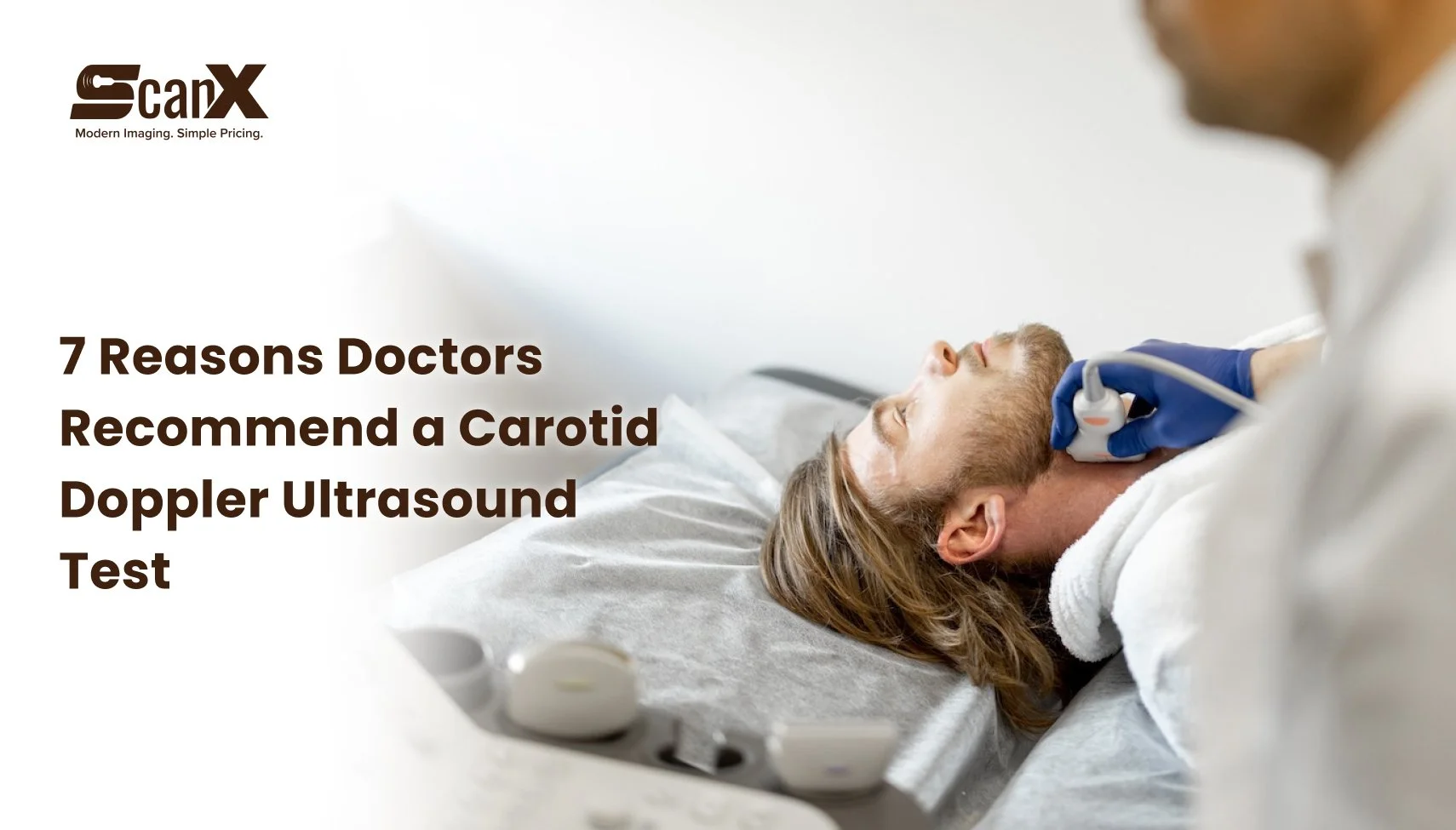
A carotid ultrasound test uses a small handheld device known as a transducer that transmits sound waves to the blood vessels in the neck. These sound waves bounce back and create clear images of the carotid arteries on a monitor. This helps doctors closely examine blood flow and detect possible problems.
A Carotid Artery Doppler ultrasound can help identify:
Atherosclerosis: Plaque buildup within the arteries
Artery Stenosis: Narrowing of the carotid arteries that reduces blood supply
Blood Clots: Clots that may increase the risk of stroke
Doctors usually advise this test for people at risk of cardiovascular disease, patients with a history of stroke, or those experiencing symptoms like dizziness, headaches, or vision problems.
Read our latest article, “Transvaginal Ultrasound Near Me: What to Expect, Cost & Benefits,” for helpful insights about the scan, its procedure, cost, and key benefits.
Interpreting Carotid Ultrasound Results
Understanding carotid ultrasound results is crucial to examining a person’s vascular and heart health. The results help doctors check how well blood circulates through the carotid arteries and determine potential problems.
The test results may show:
Normal Blood circulation: Smooth and nutrient-rich blood flow in the carotid arteries.
Plaque Buildup: Early or progressive signs of atherosclerosis in the arteries.
Reduced Blood Flow: Narrowing of the arteries (stenosis) that may demand medical care.
If any unusual consequences are found, doctors may instruct additional tests or treatment. This is why correct interpretation by a competent healthcare professional is very important.
Reasons to Get a Carotid Ultrasound Test
The doctor will advise the right scan based on the health condition of the patient. However, there are some warning signs that the patient may have problems in the carotid arteries. If these signs are noticed, then the doctor may recommend a Carotid Ultrasound Test to check blood flow and detect possible blockages.
One should consider getting a Carotid Ultrasound Test if there are the following symptoms:
1. Sudden Numbness or Weakness
Sudden weakness or numbness on one side of the body should never be ignored. If there is a sense of numbness in the face, arm, or leg on one side, it may be a warning sign of a Transient Ischemic Attack (TIA) or stroke and requires immediate medical assistance.
People with carotid artery stenosis (narrowing of the carotid arteries) often experience sudden leg weakness followed by weakness in the arm on the same side of the body. These symptoms may indicate reduced blood flow to the brain.
Medical studies present that upper limb weakness is a common indication of ischemic stroke associated with carotid artery doppler blockage. If these symptoms are experienced, doctors may recommend a Carotid Ultrasound Test to check for carotid artery narrowing or blockage. Early diagnosis can help reduce the risk of future strokes and protect brain health.
2. Vision Issues
Blurred or sudden vision problems may also be an indication of a carotid artery issue. When the carotid arteries become narrowed or blocked, it may reduce blood flow to the eyes and brain, causing temporary or sudden vision loss in one or both eyes.
In multiple cases, temporary vision loss is associated with internal carotid artery stenosis. If there are sudden or unexplained vision changes, doctors may recommend a Carotid Ultrasound Test to check for carotid artery doppler narrowing or blockage and prevent harmful conditions like stroke.
3. Discomfort While Swallowing
If there are persisting experience of difficulty swallowing without a clear reason, it should not be neglected. In certain cases, it may be connected to problems with the carotid arteries that influence blood flow to the brain.
Doctors may instruct a Carotid Ultrasound Test to check for carotid artery Doppler blockage or narrowing. Early diagnosis and prediction with a carotid artery scan can help identify potential issues and prevent serious health and wellness issues.
4. Sudden Behavioral Issues
Facing difficulties in speaking or understanding words can be a warning signal of reduced blood flow to the brain. As the carotid arteries supply oxygen-rich blood to the brain, any blockage or narrowing can influence memory, thinking, and the ability to communicate.
If symptoms such as speech problems, confusion, or memory issues arise, doctors may recommend a Carotid Ultrasound Test to check for carotid artery blockage or stenosis. Early examination with a carotid artery doppler scan can help prevent severe conditions such as stroke.
5. Dizziness and Loss of Balance
Feeling dizzy or lightheaded before fainting (syncope) may at times be an indication of carotid artery disease. If dizziness happens along with symptoms such as speech problems, weakness, or numbness, it may reflect carotid artery stenosis, which decreases blood flow to the brain.
Some people also experience constant or unexplained headaches along with dizziness. In such cases, doctors may recommend a Carotid Ultrasound Test to check for carotid artery Doppler narrowing or blockage and identify possible risks early.
6. History of Stroke or Heart Disease
People who have a history of stroke, heart disease, or a transient ischemic attack (TIA) are usually directed to undergo a Carotid Ultrasound Test. These conditions are often connected to carotid artery blockage or narrowing, which can weaken blood flow to the brain and boost the possibility of another stroke.
A carotid artery Doppler ultrasound helps doctors analyse the carotid arteries in the neck and detect plaque buildup or restricted blood flow. By finding these issues early, doctors can recommend appropriate treatment and changing lifestyles to prevent future complications.
For patients with previous stroke or cardiovascular disease, regular Carotid Ultrasound Tests play a significant role in monitoring artery health, preventing recurrent strokes, and maintaining better cardiovascular health.
7. Persistent or Unexplained Headaches
Frequent or persistent headaches without any clear reason may sometimes be connected to problems with the carotid arteries. These arteries supply oxygen-rich blood to the brain, and any narrowing or blockage can influence the appropriate circulation of blood. When blood flow to the brain is reduced, it may lead to continuous headaches, dizziness, or pressure in the head.
In such situations, doctors may instruct a Carotid Ultrasound Test to examine the carotid arteries in the neck. This non-invasive carotid artery Doppler scan helps detect plaque buildup, artery narrowing (stenosis), or other vascular issues that could be impacting brain circulation.
Getting a carotid ultrasound for undiscovered headaches can help doctors determine underlying problems early and take the appropriate steps to reduce the risk of stroke and enhance overall brain health.
Understanding Carotid Ultrasound Results
After a Carotid Ultrasound Test, doctors review the condition of the carotid arteries by evaluating the level of narrowing or blockage (stenosis). The results help define how well blood is flowing to the brain.
A 100% usual result means the carotid arteries are healthy with no narrowing or blockage. Results lower than this may reflect plaque buildup (atherosclerosis) inside the arteries.
In multiple cases, blockages below 60% are dealt with lifestyle changes, a healthy diet, and medication, remarkably in patients with a history of stroke or transient ischemic attack (TIA). However, severe blockage above 60% may require medical procedures such as carotid endarterectomy, a treatment used to extract plaque and restore appropriate blood flow to the brain.
Check our wide range of cost-effective imaging services at ScanX, including Carotid Ultrasound Thyroid Ultrasound, Liver Ultrasound, Kidney Ultrasound, Gallbladder Ultrasound, Abdominal Ultrasound, Hernia Ultrasound, FibroScan Liver Elastography, and AAA Screening.
Consult a ScanX Specialist for a Carotid Ultrasound Test
ScanX is an advanced imaging center with experienced sonographers and radiologists who specialize in performing diagnostic ultrasound tests. We focus on identifying conditions related to the cardiac system, including arteries and veins, through accurate imaging.
The carotid arteries are important blood vessels that supply oxygen-rich blood to the brain. Any issue with these arteries requires proper medical evaluation. If you experience symptoms such as dizziness, weakness, speech difficulties, or vision changes, you should first consult a qualified doctor.
Based on your condition, your doctor may recommend a Carotid Ultrasound Test. At ScanX, we perform this test to help detect narrowing or blockages in the carotid arteries. The results are then shared with your doctor, who can guide you with the appropriate treatment if needed.
Redefining Diagnostic Imaging in Dallas–Fort Worth
ScanX makes ultrasound imaging economical, transparent, and patient-friendly in Dallas Fort Worth and Fairview, TX. With clear self-pay pricing, no hidden fees, and no insurance hassles, ScanX delivers hospital-quality diagnostic scans performed by expert sonographers and reviewed by board-certified radiologists at a much lower cost.
To discover more on the cost difference between insurance and self-pay options at ScanX, explore our blog: “Understanding the Cost Differences Between Insurance and Self-Pay at ScanX.”
Conclusion
A Carotid Doppler Ultrasound is a significant test used to find carotid artery disease, measure the risk of stroke, and assess overall vascular health. This non-invasive scan helps doctors determine blockages or narrowing in the carotid arteries at an early stage. Early screening through a carotid artery Doppler scan allows timely treatment and helps prevent serious health and wellness issues.
For accurate and reliable diagnostic imaging, choose ScanX Care for professional Carotid Doppler Ultrasound services. Patients can explore the ScanX Patient Referrals to get connected with affordable diagnostic imaging services through a fast and convenient process.
Call today to book your Carotid Doppler Ultrasound Test and ensure experienced professionals check your vascular health.
Healthcare made simple that’s the ScanX way.